
Barrier Repair Cream Comparison: Cicaplast vs Cicalfate vs Ultra Repair Cream
A compromised skin barrier makes ordinary moisturizer shopping feel harder than it should. One cream feels too greasy, another stings, and a third looks gentle until the ingredient list gets complicated. That is why Cicaplast, Cicalfate, and Ultra Repair Cream are often compared in the same conversation: all three are positioned for dry, sensitive, or irritated skin, but they do not solve the same problem in the same way.
Our view is simple: this barrier repair cream comparison should start with use case, not hype. Cicaplast Balm B5+ is the targeted balm pick, Avène Cicalfate+ is the richer protective cream, and First Aid Beauty Ultra Repair Cream is the everyday face-and-body moisturizer.
Disclosure: Adpard may earn a commission if you choose to buy through product links, at no extra cost to you. Our editorial process is explained on our about page and editorial policy. We did not conduct first-hand clinical testing for this article; this comparison is based on official product pages, ingredient lists, and source-backed editorial review.
Quick Decision: Which Barrier Cream Fits Your Skin?
If your skin is dry in a few specific areas, such as around the nose, lips, hands, or wind-chapped patches, start with La Roche-Posay Cicaplast Balm B5+. The official product page lists dimethicone as the active skin protectant and highlights panthenol, madecassoside, shea butter, and a prebiotic complex. That makes it the most targeted option in this comparison.
If your skin feels more broadly uncomfortable, rough, or visibly irritated, Avène Cicalfate+ Restorative Protective Cream is the richer protective choice. Avène describes it as a multi-purpose skin barrier cream with C+ Restore, copper-zinc sulfate complex, and thermal spring water. It is also listed as fragrance-free, alcohol-free, silicone-free, and non-comedogenic on the official page.
If you want a daily cream for face and body, First Aid Beauty Ultra Repair Cream Intense Hydration is the most moisturizer-like option. First Aid Beauty positions it for dry, combination, oily, eczema-prone, and sensitive skin, with 0.5% colloidal oatmeal, ceramides, shea butter, and squalane in the formula story.
Barrier Repair Cream Comparison Table
| Product | Strongest fit | Texture direction | Key source-backed ingredients | Price checked May 26, 2026 | Watch-outs |
|---|---|---|---|---|---|
| La Roche-Posay Cicaplast Balm B5+ | Targeted dry or chapped patches | Balm-cream, protective | 1% dimethicone, panthenol, madecassoside, shea butter, Tribioma | $18.99 for 40ML; $32.99 for 100ML on official US page | Can feel too occlusive if used all over oily areas |
| Avène Cicalfate+ Restorative Protective Cream | Richer protection for irritated or very dry skin | Rich protective cream | Avène thermal spring water, zinc oxide, mineral oil, C+ Restore, copper-zinc sulfate | $26-$40 on official US page | Richer feel may not suit users who dislike protective layers |
| First Aid Beauty Ultra Repair Cream | Daily face-and-body dry skin hydration | Cream moisturizer | 0.5% colloidal oatmeal, ceramides, shea butter, squalane | $42 for 6 oz on official US page | Contains eucalyptus leaf oil in the listed ingredients, which some highly reactive users may want to review carefully |
Prices and product details can change. Always check the current product page and the packaging you receive, especially if you have allergies or a medical skin condition.
La Roche-Posay Cicaplast Balm B5+: Targeted Balm for Chapped, Dry, or Irritated Areas
Cicaplast Balm B5+ is the most targeted barrier product in this comparison. La Roche-Posay describes it as a soothing therapeutic multi-purpose cream for dry skin irritations, chapped skin, chafed skin, cracked hands, elbows, rough knees, feet, diaper rash, and sensitive skin. The brand also says it can be used on the face, body, hands, and lips, while avoiding the eye area.
The ingredient story is straightforward. The official US product page lists dimethicone 1% as the active ingredient, with inactive ingredients including glycerin, shea butter, panthenol, centella asiatica leaf extract, madecassoside, zinc gluconate, manganese gluconate, and a prebiotic complex. That makes Cicaplast a good fit when the goal is to protect a specific irritated area rather than replace a normal daily moisturizer.
The main reason to choose Cicaplast is control. It is easier to reserve for dry patches, post-wind irritation, chapped areas, or a final layer on specific spots. The main reason to skip it is also texture: if your whole face gets congested easily or you dislike a balm-like finish, you may prefer a cream that behaves more like a daily moisturizer.
Practical recommendation: choose Cicaplast when your routine already has a lightweight moisturizer, but you need a stronger final layer for limited irritated areas.
Avène Cicalfate+ Restorative Protective Cream: Richer Protective Cream for Sensitive, Dry Skin
Avène Cicalfate+ is the richer, more protective-feeling choice. The official page describes it as a multi-purpose skin barrier solution for sensitive skin prone to visible redness or dryness, minor cuts and scrapes, perioral area, cracked or chapped skin, diaper area, after sun exposure, and other irritation-prone use cases. It is also listed as safe for infants, children, and adults.
The formula direction is different from Cicaplast. Avène lists thermal spring water, caprylic/capric triglyceride, mineral oil, glycerin, hydrogenated vegetable oil, zinc oxide, propylene glycol, C+ Restore postbiotic ingredient, beeswax, copper sulfate, and zinc sulfate. The official page also says it is fragrance-free, paraben-free, sulfate-free, alcohol-free, silicone-free, and non-comedogenic.
Choose Cicalfate+ if your skin wants a more enveloping protective cream and you are comfortable with a richer layer. It makes the most sense for dry, delicate, visibly irritated, or family-use scenarios where a simple “daily moisturizer” does not feel like enough.
Skip it if you want the lightest possible finish under sunscreen or makeup. The richness is the point, but that also makes it less flexible for oily or very product-sensitive routines.
Practical recommendation: choose Cicalfate+ when barrier comfort matters more than cosmetic elegance.
First Aid Beauty Ultra Repair Cream: Everyday Face-and-Body Hydration
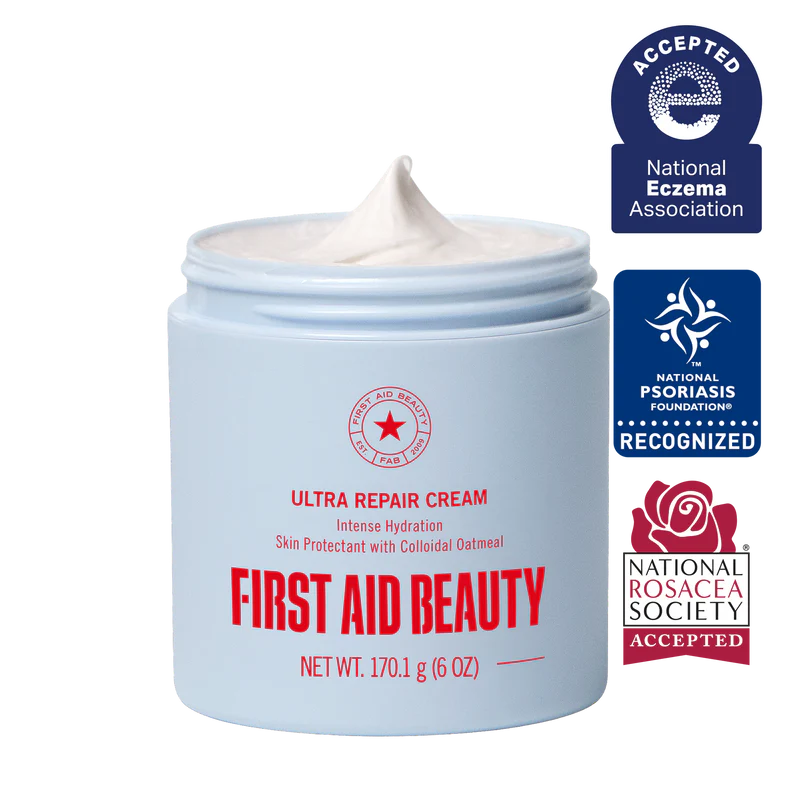
Ultra Repair Cream is the broadest daily-use option here. First Aid Beauty positions it for dry, combination, oily, eczema-prone, and sensitive skin, and the official page says it can be applied from head to toe once or twice daily, or as needed. That makes it a better fit for readers who want one tub-style cream for face, body, hands, and seasonal dryness.
The formula story centers on 0.5% colloidal oatmeal, ceramides, shea butter, squalane, allantoin, licorice root extract, green tea extract, and feverfew extract. First Aid Beauty also states that the product is accepted by the National Eczema Association and cites hydration and consumer-perception results on the product page.
Compared with Cicaplast and Cicalfate, Ultra Repair Cream is less of a “spot repair balm” and more of a daily comfort cream. That can be useful if you do not want to keep a separate balm in your routine. It can also be less ideal if you specifically want a dense occlusive layer for a small chapped area.
One ingredient note: the official ingredient list includes eucalyptus globulus leaf oil. Many users tolerate the formula, but highly reactive skin should review the full ingredient list and patch test.
Practical recommendation: choose Ultra Repair Cream when your main problem is recurring dryness across face and body, not one specific raw patch.
Cicaplast vs Cicalfate: The Closest Head-to-Head
The closest comparison is Cicaplast vs Cicalfate because both live in the French pharmacy “cica” barrier-care lane. The difference is not that one is universally better. The difference is how they behave in a routine.
Cicaplast is easier to use as a targeted balm over dry patches. It has a dimethicone skin-protectant structure, panthenol, madecassoside, and shea butter. It makes sense when the skin issue is local: corners of the mouth, rough cheeks after wind, dry nose area, chapped hands, or a patch that needs a final protective layer.
Cicalfate+ feels more like a rich protective cream. Its official ingredient list includes mineral oil, zinc oxide, beeswax, copper sulfate, and zinc sulfate, alongside Avène thermal spring water and the C+ Restore postbiotic ingredient. It makes sense when the irritated area is larger, drier, or more uncomfortable.
If you are choosing between only those two, ask one question: do you want a targeted balm or a richer cream? That answer matters more than the brand name.
Where Ultra Repair Cream Fits in the Comparison
Ultra Repair Cream is not a direct cica-balm duplicate. It sits between a body cream, face moisturizer, and eczema-prone skin comfort product. That is why it is useful in the comparison: many buyers do not actually need a dense balm every day. They need a moisturizer they can use consistently.
If you already own a light gel cream and only need help when your barrier is stressed, Cicaplast or Cicalfate+ is the more logical add-on. If your skin is dry most days and you want one cream for face and body, Ultra Repair Cream may be the more practical purchase.
This is also where ingredient preference matters. Colloidal oatmeal and ceramides point Ultra Repair Cream toward daily dry-skin support. Dimethicone, zinc oxide, mineral oil, and heavier protective ingredients point the other two toward more targeted barrier support.
How to Use These Creams Without Overcomplicating Your Routine
Start with a gentle cleanser, then apply any water-based serum you already tolerate. Add your normal moisturizer if you use one. Place the barrier cream last, especially if the product is thick or protective.
For Cicaplast, use a thin layer on the dry or irritated area. It does not need to become an all-over mask unless your skin tolerates that approach.
For Cicalfate+, apply to clean, dry skin as Avène directs. Because it is richer, start with a small amount and increase only if your skin feels comfortable.
For Ultra Repair Cream, use it as the moisturizer step. It can be applied to face or body, but patch testing is still sensible if you are prone to stinging or redness.
Do not use any of these products as a substitute for medical care. If you have persistent eczema, infection signs, open wounds, severe burning, or a post-procedure concern, ask a dermatologist or clinician.
Internal Reading Path
If you want a broader shortlist before choosing one product, start with our guide to barrier repair moisturizers for sensitive skin. For brand-level context, keep these internal notes open as the site expands: La Roche-Posay, Avène, and First Aid Beauty.
FAQ
Is Cicaplast or Cicalfate better for sensitive skin?
Neither is automatically better for every sensitive-skin routine. Cicaplast is the more targeted balm-style option, while Cicalfate+ is the richer protective cream. If your concern is a small chapped patch, Cicaplast may be easier to place. If your concern is broader dryness or visible irritation, Cicalfate+ may feel more protective.
Can I use Cicaplast, Cicalfate, or Ultra Repair Cream on my face?
The official pages describe face use for these products, but the right fit depends on your skin and routine. Use a small amount first, avoid the eye area unless the product specifically says otherwise, and patch test if you are reactive. Oily or acne-prone users may prefer targeted application.
Which cream is better under sunscreen or makeup?
Ultra Repair Cream is the most moisturizer-like option, so it may be easier for daytime use. Cicaplast can work on targeted areas, but may feel more noticeable. Cicalfate+ is richer and may be better for comfort than cosmetic layering. Let each layer settle before applying sunscreen.
Are these barrier creams fragrance-free?
The official pages list Cicaplast Balm B5+ and Cicalfate+ as fragrance-free. First Aid Beauty positions Ultra Repair Cream as gentle and suitable for sensitive skin, and the product page lists eucalyptus globulus leaf oil in the ingredients. If fragrance or essential oils trigger your skin, read the current packaging before buying.
Which one should I buy first?
For a targeted irritated patch, start with Cicaplast. For a richer protective cream, start with Cicalfate+. For everyday dry skin across face and body, start with Ultra Repair Cream. The right purchase is the one that matches how often, where, and why you plan to use it.
Title Candidates
- Barrier Repair Cream Comparison: Cicaplast vs Cicalfate vs Ultra Repair Cream for Sensitive or Irritated Skin
- Cicaplast vs Cicalfate vs Ultra Repair Cream: Which Sensitive-Skin Cream Fits Your Routine?
- Three Barrier Repair Creams Compared by Texture, Ingredients, and Sensitive-Skin Use Case
- The Practical Difference Between Cicaplast, Cicalfate, and Ultra Repair Cream
- Which Barrier Cream Should You Use for Dry, Chapped, or Post-Active Skin?
Sources Checked
- La Roche-Posay Cicaplast Balm B5+ official US product page
- Avène Cicalfate+ Restorative Protective Cream official product page
- First Aid Beauty Ultra Repair Cream Intense Hydration official product page
- American Academy of Dermatology eczema-friendly moisturizer guidance PDF
- Allure barrier-repairing cream roundup, 2026
The practical choice is not the product with the loudest reputation. It is the product whose texture, ingredient direction, and use case match the way your skin actually fails when it gets dry or irritated.